Case Study
PUR Waters
Extending the digital experience by
- E-Commerce Integration
- Water Quality Map Innovation
- SaaS & Live Chat Integration
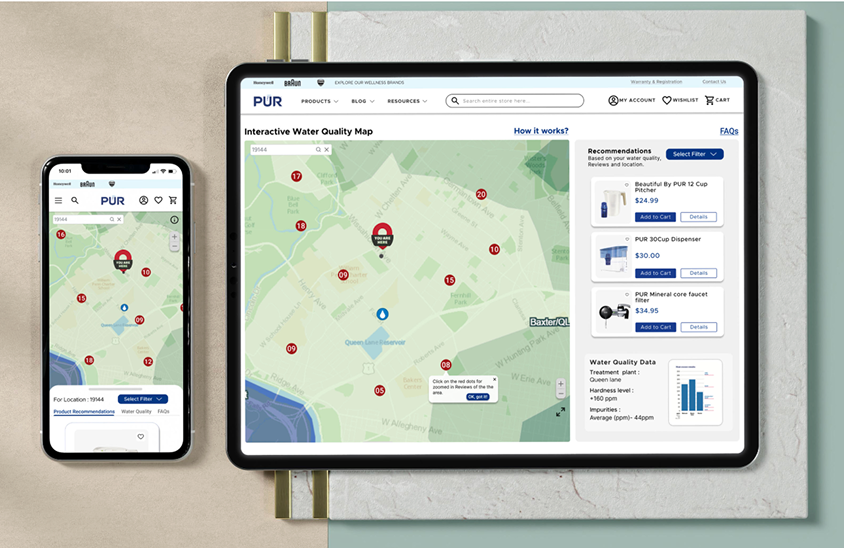
Overview
From informational to indispensable.
PUR came to us with a problem they couldn't ignore. Their site did the hard part well. It built real brand trust and guided people through their product range. Then it stopped. There was no way to buy. Motivated users at peak purchase intent would hit a dead end, open Amazon, and either grab a competitor or close the tab. PUR was teaching its customers to buy from someone else.
On a team of three UX designers, I led the brand research and competitive benchmarking that grounded our direction, drove the idea and design of the Water Quality Map feature, and owned the annotated UI documentation across the project. The e-commerce flow and live chat integration ran in parallel as shared workstreams.
The goal wasn't "more information." It was closing the loop between "I trust this brand" and "I just bought something."
"Can I actually buy this here, or do I have to go somewhere else?"
"Is my ZIP code's water even a problem worth solving?"
"If I get stuck, can someone help me right now?"
Project Goal
Design a complete trust-to-purchase journey.
Seamless Browse → Decide → Buy
Build a complete e-commerce flow inside PUR. No more dead ends, no redirecting to Amazon.
Reduce Filter Selection Confusion
Help users identify the right product for their home without needing to research elsewhere.
Build Trust Through Transparency
Surface local, relevant data that turns abstract concern into a confident, informed decision.
Increase Engagement & Conversion
Reduce drop-off at every friction point: product pages, checkout, and last-minute hesitation.
About the Client
Who is PUR?
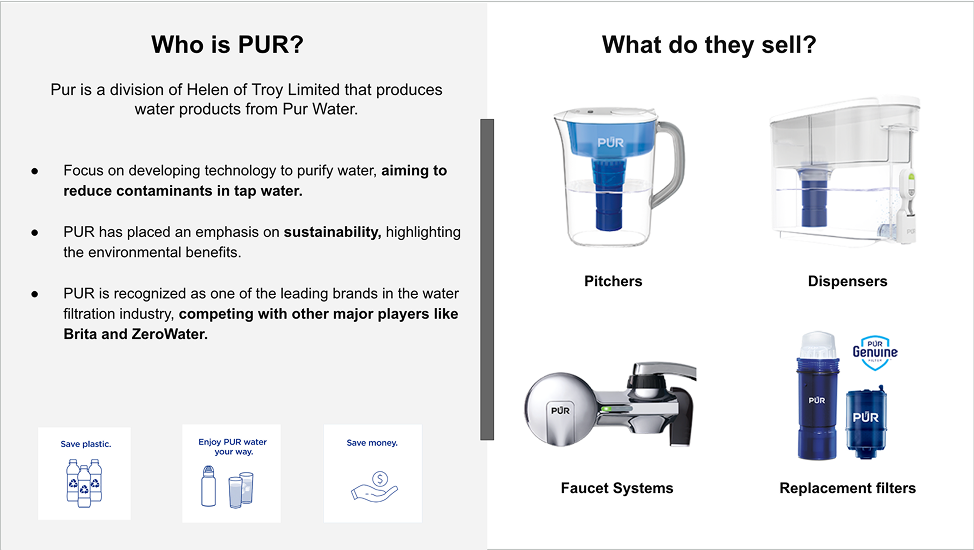
PUR is one of North America's leading water filtration brands. Pitchers, faucet filters, and replacement cartridges trusted in millions of homes. At the time of this project, no direct path to purchase on their own site.
- Sold through major retail partners including Target and Walmart
- BPA-free, sustainability-focused, long-lasting filter cartridges
- Competing directly with Brita on filtration technology
Part 01 of 03 · E-Commerce Integration
From Browsing to Buying.
PUR's site was a teaching tool pretending to be a store. Users could explore products, build confidence in the brand, and then hit a wall.
The buy action simply wasn't there. They'd leave, open Amazon, lose all the context they'd just built, and either buy something else or nothing at all. We rebuilt the full path: browse, evaluate, decide, checkout, all inside PUR.
The Journey Redesign
Old Journey
Broken loop: user exits the ecosystem before converting.
New Journey
Complete loop: confidence built, purchase completed, trust earned.
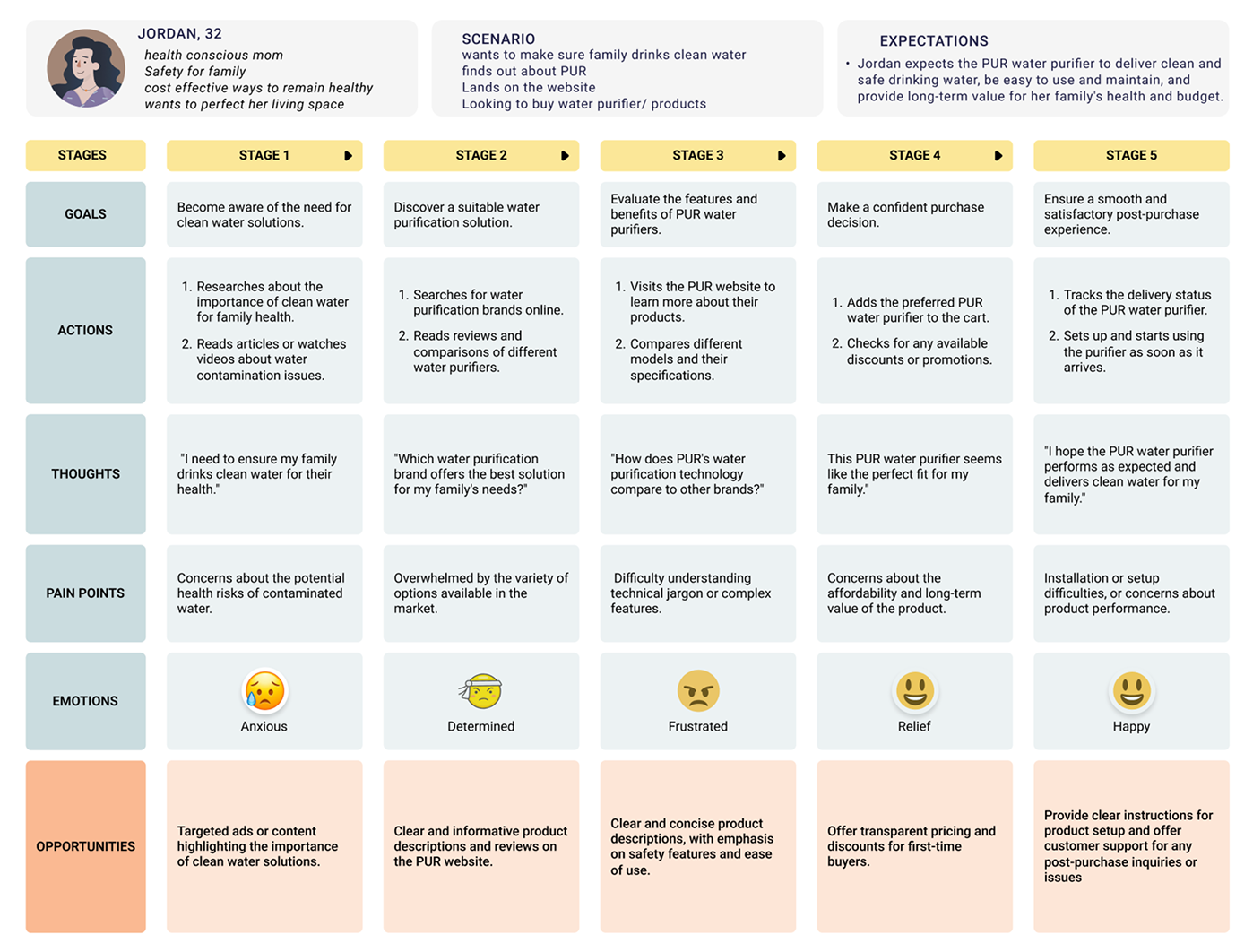
User Journey Map
Jordan, a health-conscious mother of two, navigating the full purchase journey from awareness to post-purchase.
E-Commerce Integration
The redesigned product catalogue with integrated cart. Users can browse, filter, and purchase without leaving the PUR ecosystem.
Try it yourself
View E-Commerce PrototypePart 02 of 03 · Water Quality Map
Making Water Quality Visible.
We started this project assuming users were confused about which filter to buy. Research said otherwise.
Users understood the products fine. What they couldn't answer was whether their specific water, in their specific home, actually needed filtering. The gap wasn't product literacy. It was local relevance. If we'd skipped this step, we'd have built a better comparison page and missed the real blocker entirely.
"How do you turn 'water quality' from an abstract worry into a local, personal fact?"
Where Trust Broke Down
Three moments in the Evaluate stage where users hit uncertainty, stalled, and eventually left to research elsewhere.
Zooming into the Evaluate stage, where trust broke down and users abandoned the decision process.
"We help health-conscious individuals make informed decisions about their water filtration needs by offering an interactive community Water Quality Map that provides real-time data and personalized recommendations based on location."
The Hardest Call
The map depended on reviews from real people in real neighborhoods, and we had to trust they'd show up. Community features die when they launch empty. Our bet: seed the map with public utility data so it never felt dead, add a modest review incentive, and lean on market research that said people do share local knowledge when the payoff is obvious. If we'd waited for certainty, the feature would never have shipped.
User Flow
How a user moves from not knowing anything to buying the right filter in four steps.
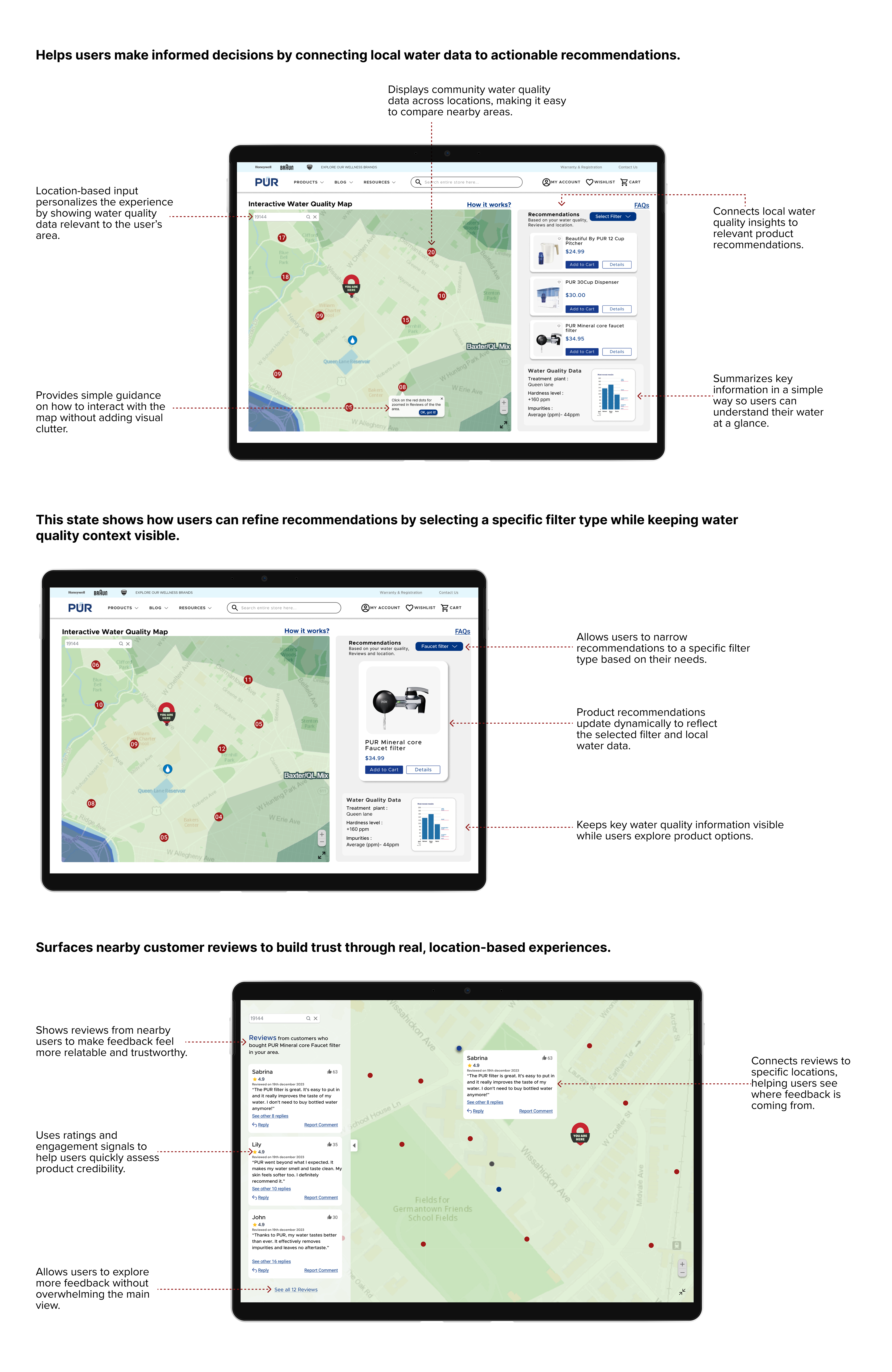
Annotated UI Screens
Design rationale, interaction states, and edge case documentation for the Water Quality Map feature.
Try it yourself
Part 03 of 03 · Live Chat Support
Reducing Last Minute Hesitation.
"How do you answer 'I'm not sure' without sounding like a sales pitch?"
Some users did everything right. They understood the product, saw their local data, picked the right filter. And still paused at checkout. That pause wasn't an information gap. It was an anxiety spike at the exact moment someone hands over a credit card. An FAQ wouldn't fix it. A human voice might.
The Intervention
We placed a contextual live chat trigger at the checkout hesitation point. Not a generic support widget, but a moment-aware prompt that appeared only when the user had been idle for more than 8 seconds on the payment screen.
Live chat integration: real-time support surfaced at the exact hesitation moment.
Conversation Design · Key Capabilities
The chat system was designed to match PUR's brand tone: helpful, not pushy. Each conversation state was scripted and mapped:
Conclusion
Three parts. One complete journey.
PUR's gap wasn't one big problem. It was three smaller ones stacked on top of each other: no way to buy, no reason to trust the decision, no support when doubt crept in. Each part of this project solved one layer. The combined effect was the thing PUR came to us wanting in the first place: customers who never had to leave.
Complete browse-to-buy journey: users can discover, evaluate, and purchase without leaving the ecosystem.
Water quality made visible and locally relevant, with the right filter recommendation grounded in real data.
Last-mile hesitation reduced, with real-time support at the exact moment doubt would have caused drop-off.
What I'd Do Differently
Ship the Water Quality Map with real EPA data from day one rather than a prototype flow. The concept only earns full trust if the data is real. A map that shows you your neighborhood's actual water report is genuinely useful. A map that simulates it is just a feature demo. The gap between those two things is the difference between a product people tell their neighbors about and one they forget the next day.
What's next: Validate data source partnerships for the Water Quality Map, measure conversion behavior post-launch, and explore scaling the live chat support layer with AI-assisted triage to handle volume without sacrificing the human touch.