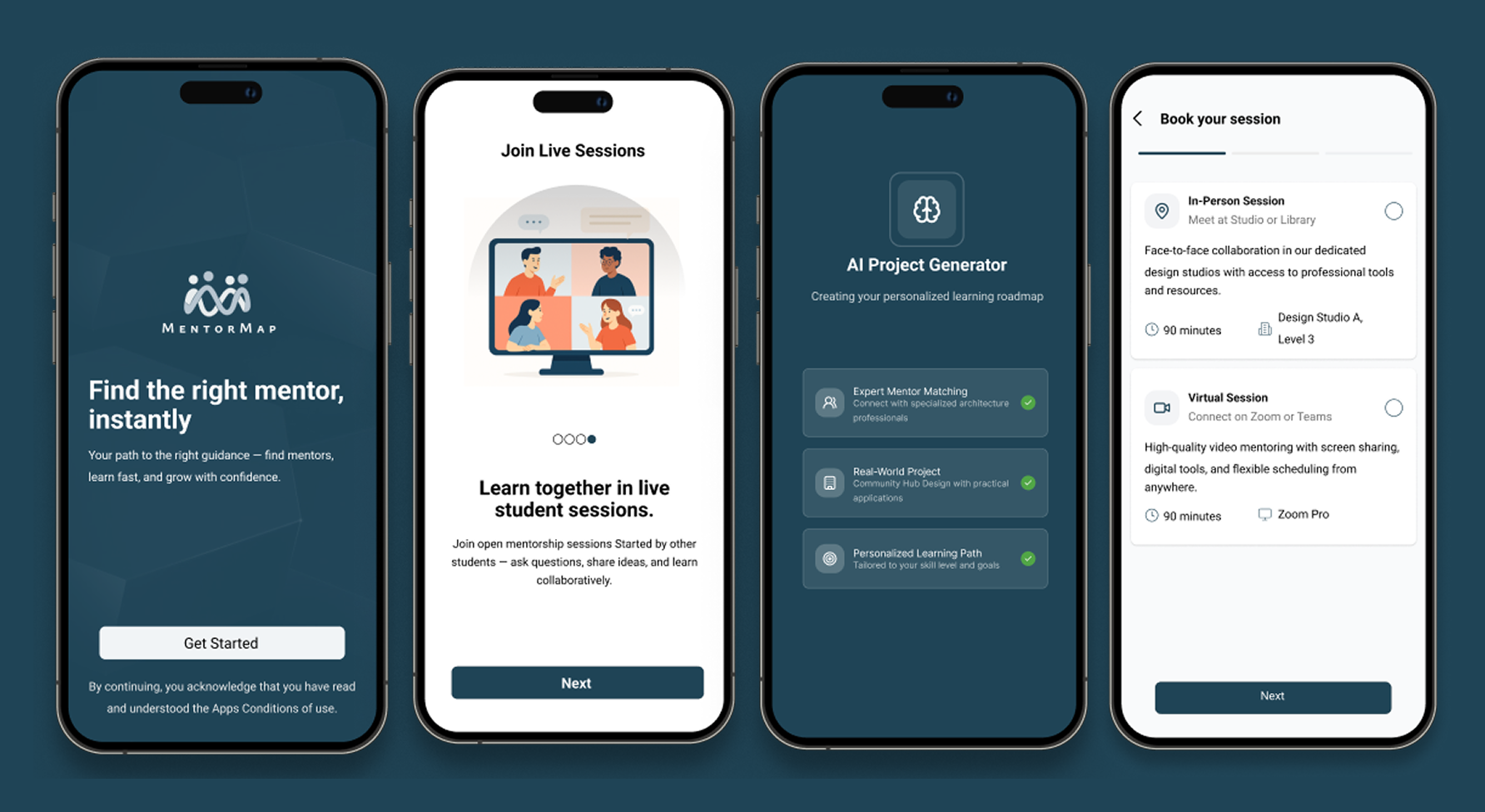
Case Study
MentorMap
The help architecture students need is usually three desks down. Most can't see it.
Overview
Every existing solution misses the real shape of the problem.
One studio project takes 20 to 25 distinct skills. Rhino, Grasshopper, Revit, V-Ray, Lumion, parametric modeling, fabrication, working drawings, rendering. Nobody masters all of them. Most students go deep on two or three. The expertise to fill in the rest is sitting in the same studio.
Every existing solution treats this as a matching problem. ADPList, LinkedIn, university Slack channels, formal mentorship programs. They all try to find more mentors or build a better directory. That assumption misses the real shape of the problem.
"I spent hours searching online just to solve small issues in software. A mentor could have told me the answer in two minutes."
P2
"Eventually I understood that for everything, you have to go to an expert and ask."
P4
The brief stopped being "build a mentorship app" and became "make the existing help-seeking system visible."
Part 01
The expertise is already in the room. Students just can't see it.
Research · 13 interviews · affinity mapping · problem tree
13 interviews. Four patterns. One root cause.
13 interviews across current students, faculty, and recent graduates. Synthesized through affinity mapping, a studio journey map, and a problem tree.
Inefficiencies. Students burned days on problems a mentor could solve in two minutes. They knew this. They still burned the days.
Identifying the right mentor. Most students assumed "mentor" meant a senior or a professor. They missed peers sitting next to them.
Hesitation. Studio culture treats interruption as rude. Introverts had it worst.
Access barriers. Formal mentorship lived behind email threads. Informal mentorship depended on already knowing the right people, which is exactly what new students don't have.
Root cause: distributed expertise is invisible. Students default to whoever is easiest to reach. The best-suited mentors stay invisible.
Problem tree: where help-seeking breaks down at architecture school.
What invisibility actually costs students.
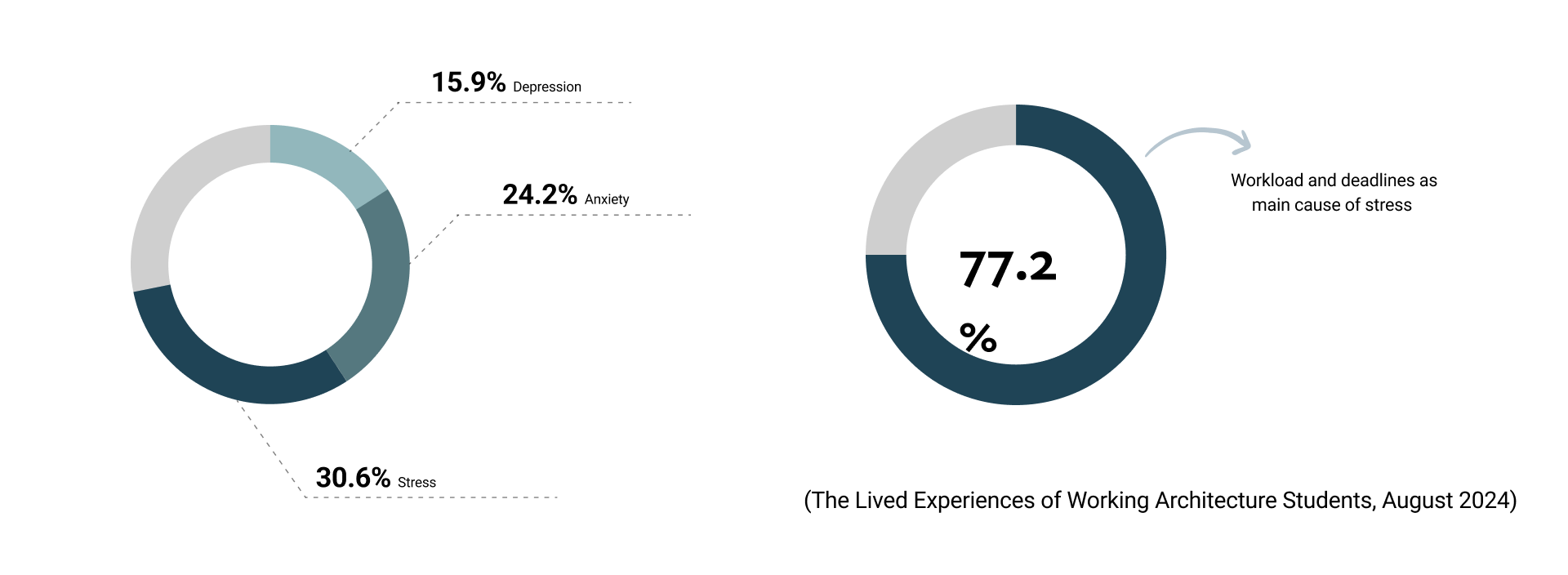
24.2% of architecture students experienced anxiety, 30.6% experienced stress, 77.2% cited workload as the cause (American College Health Association, 2017; Lived Experiences study, 2024). Without peer mentors, students were 4.16x more likely to consider leaving university in their first 10 weeks (Collings et al., 2014).
"Because we don't want people pulling all-nighters." The studios were locked. The help-seeking system wasn't.
anxiety in architecture students
experienced stress
more likely to consider leaving without peer mentors
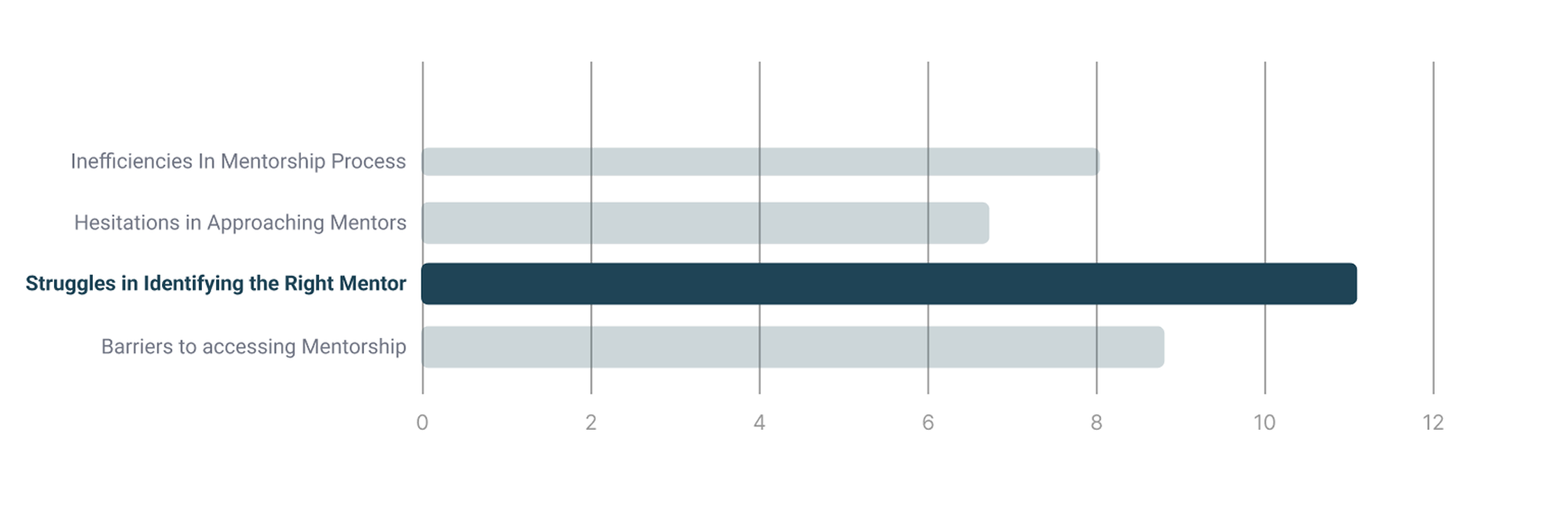
The numbers behind the qualitative pattern.
The question that killed every other version of the product.
How might we make it easier for architecture students to see who can support them with the specific skills, tools, or guidance they need at each stage of their education?
This line killed the "build another LinkedIn" version of the product. Every feature that got cut, every pretotype that got run, every fix that got shipped traces back to it.
Part 02
Help-seeking happens in hallways. The product had to live there too.
Product design · user flows · wireframes · AI features · MVP scoping
Why help has to live in the hallway.
Students don't seek help from a phone at their desk in the middle of a panic. They seek help in transitional moments. Walking between classes. Refilling coffee. Standing in the hallway looking at a printed plan.
The Skill Wall is a physical board in the studio hallway. Mentor cards live on the wall with skills, availability, and a QR code. The QR opens directly to that mentor's profile. Booking, messaging, and live sessions happen in the digital layer.
The wall handles visibility. The app handles action. Both have to exist because the help-seeking behavior splits between physical attention and digital follow-through.
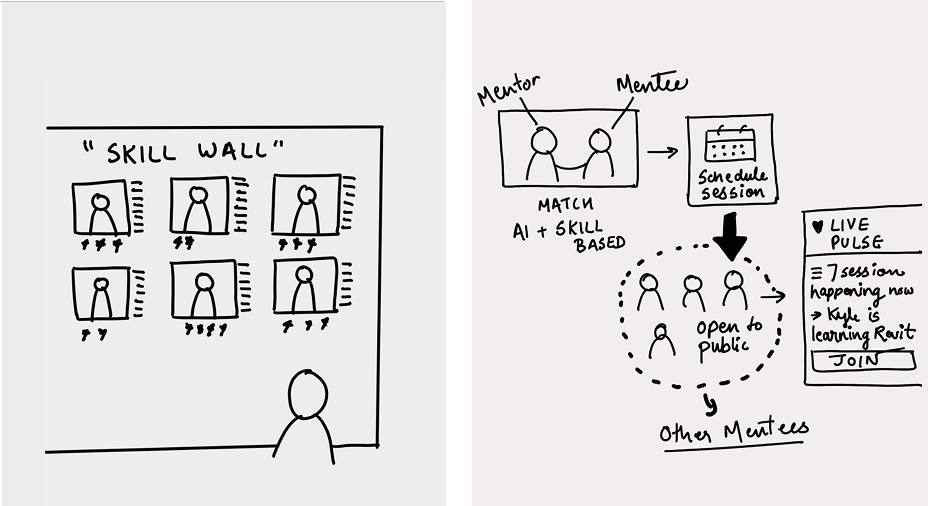
From sketch to system: pairing the Skill Wall with the app.
Twenty-six features considered. Seven survived.
A MoSCoW analysis on 26 features locked the MVP to seven Must-Haves:
Recognition badges, AR mentor gallery, voice booking, interactive whiteboard: cut. They expand the platform without proving the visibility hypothesis. That hypothesis is the whole thesis.
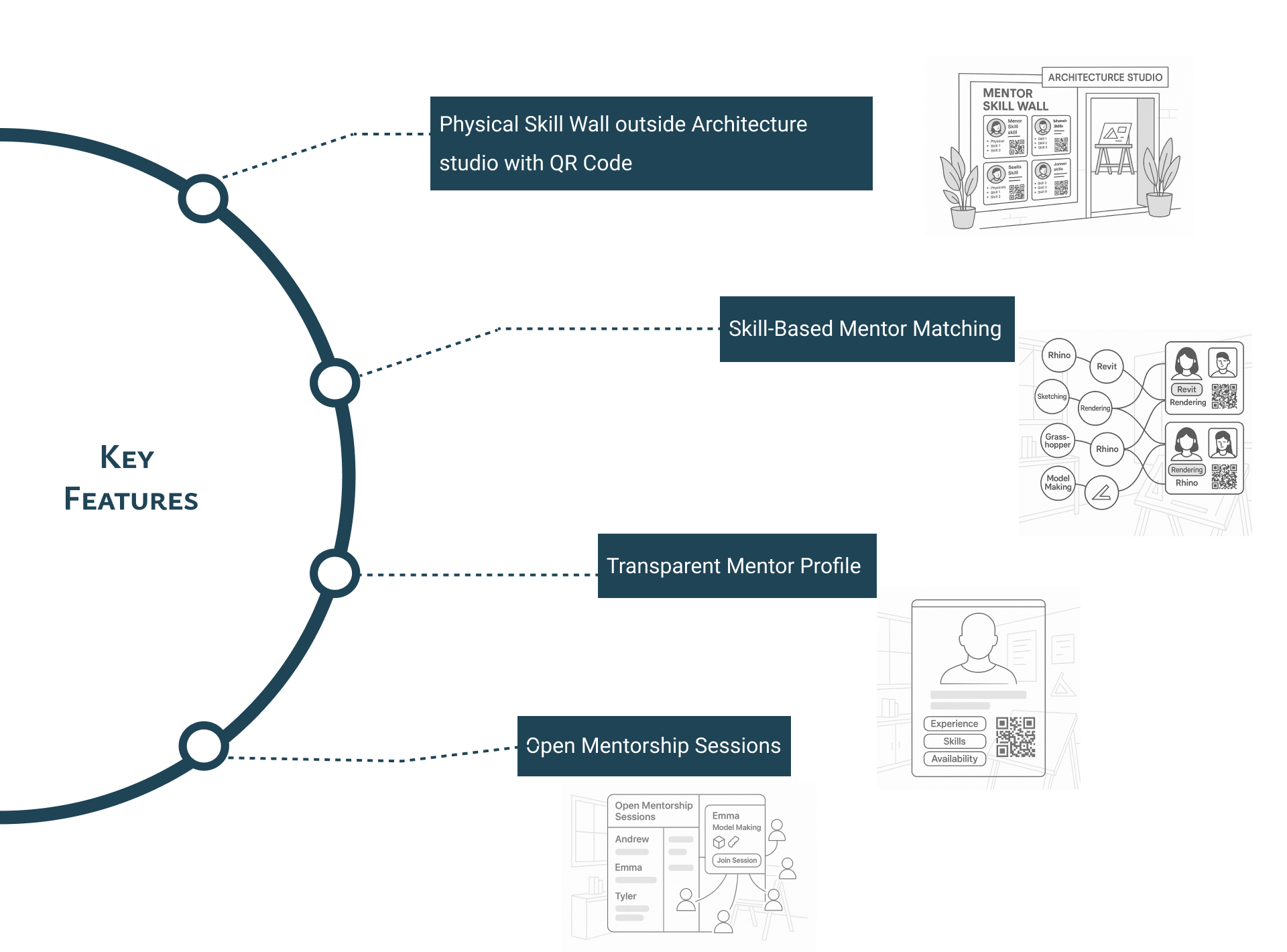
Seven features. Each one earns its place by serving the visibility hypothesis.
How a student actually finds someone in three taps.
Two flows mattered most: onboarding (cold-start trust) and homepage discovery (the moment a student has to find someone).
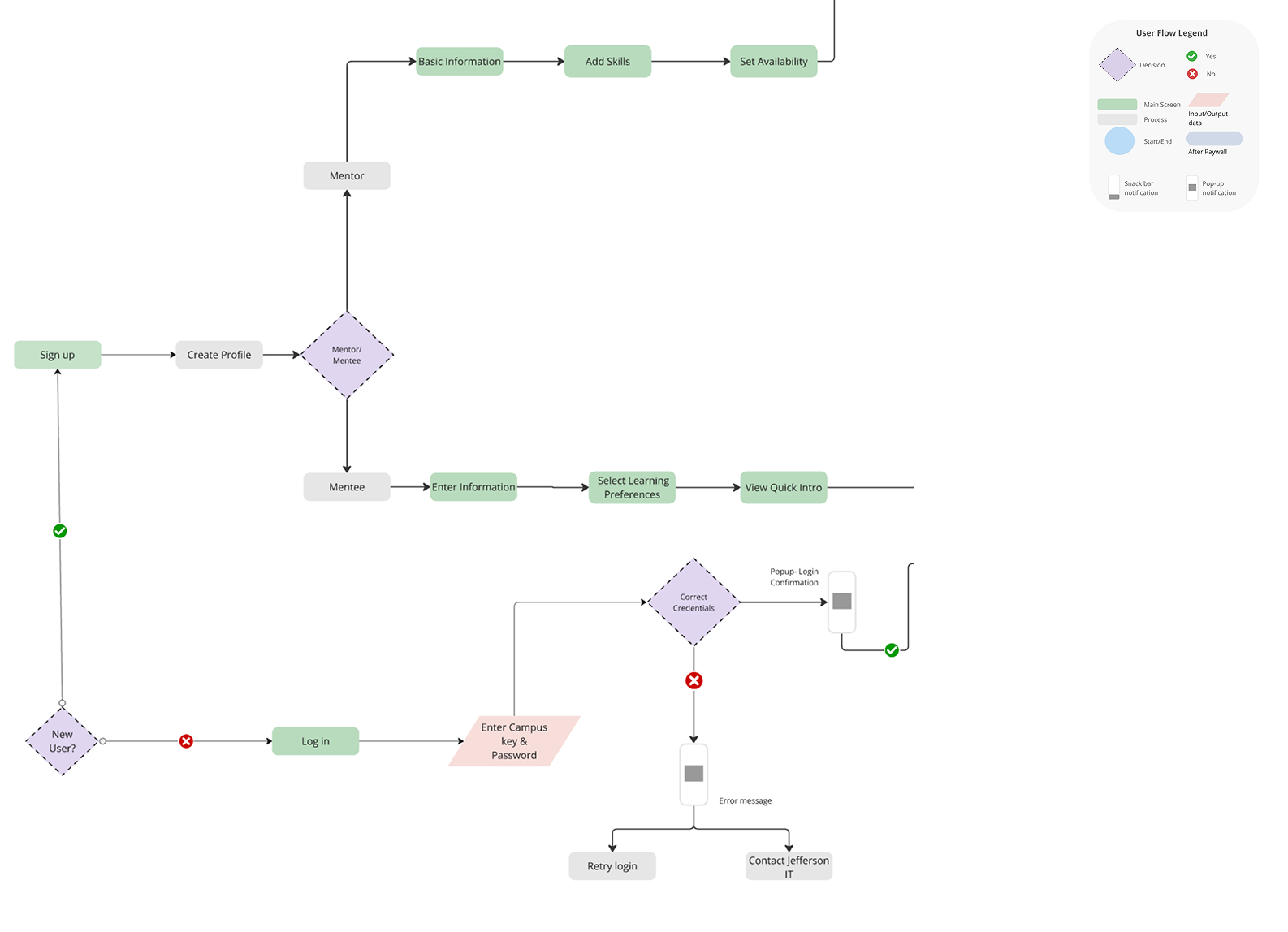
Onboarding: surfaces skills before profile polish, so the system has signal from minute one.
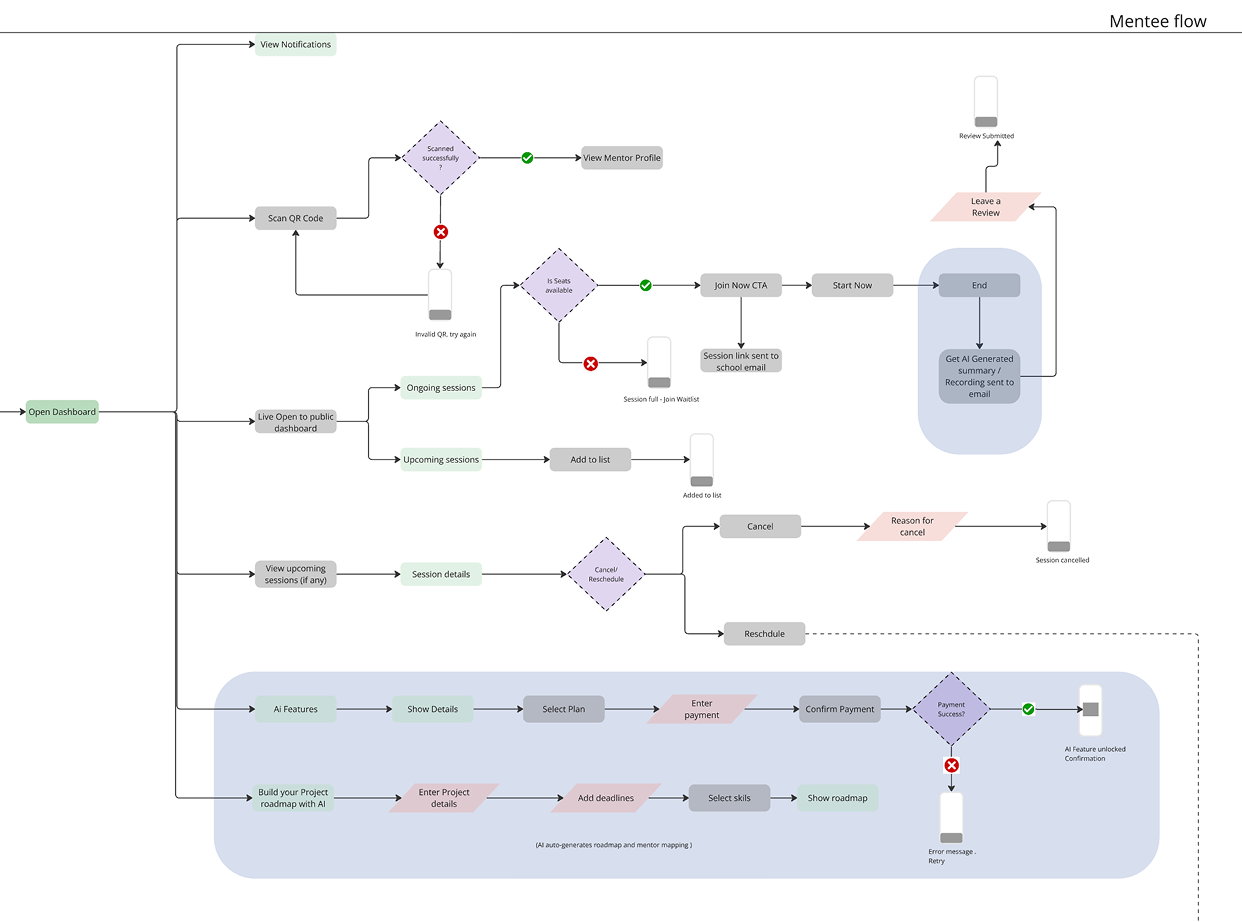
Homepage: every path lands on a mentor profile within three taps.
Wireframes locked the structure before any visual decisions.
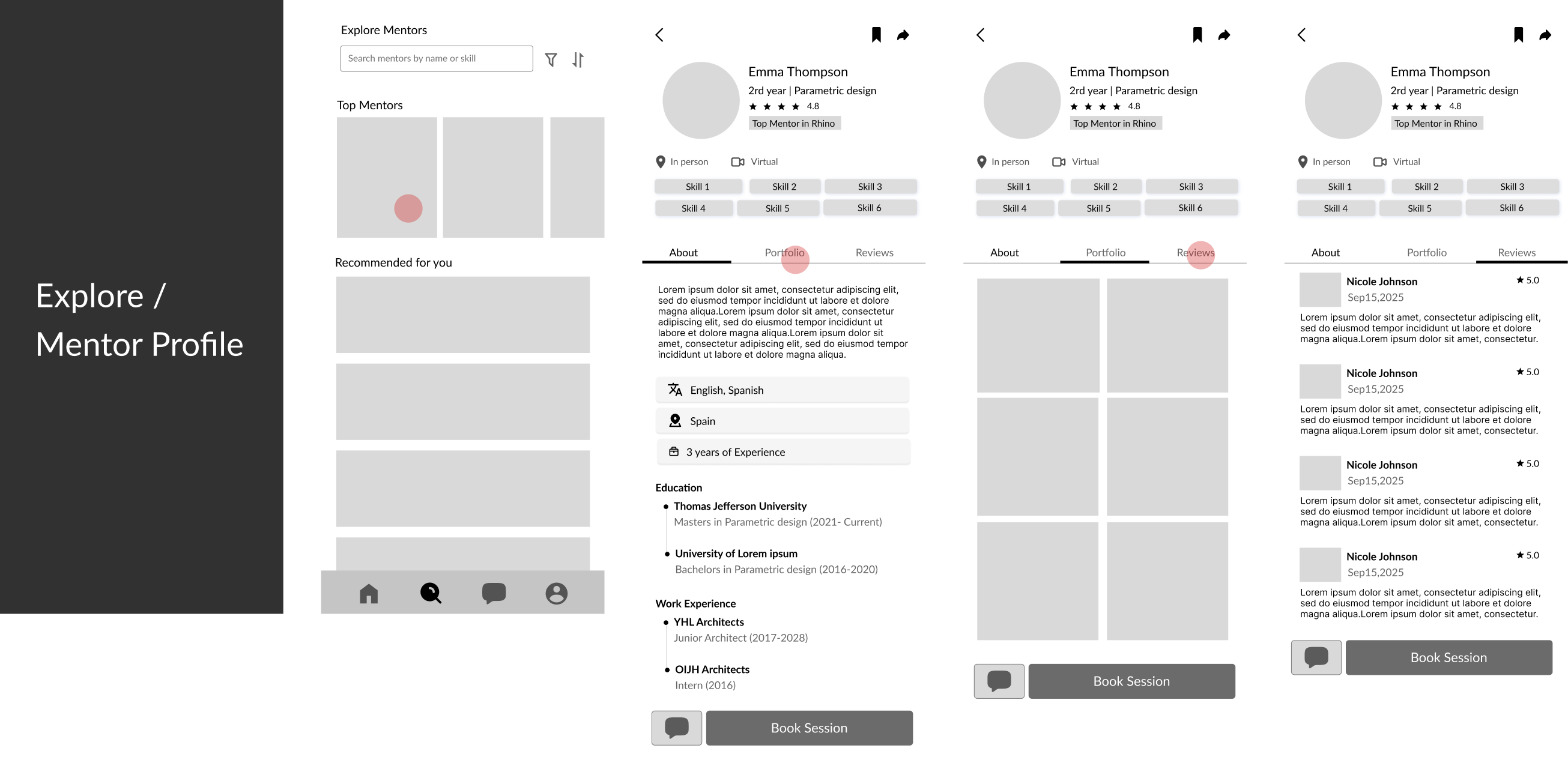
Wireframes locked the navigation model before any visual decisions.
A mentor profile you can read in three seconds.
The header gives expertise, rating, availability, and an In-Person / Virtual toggle. Skill tags below let students scan specialties without reading paragraphs. Tabs for About, Portfolio, Reviews keep the page short. Book Session CTA sticks to the bottom on long profiles. (That stickiness was a usability-test fix. See Part 04.)
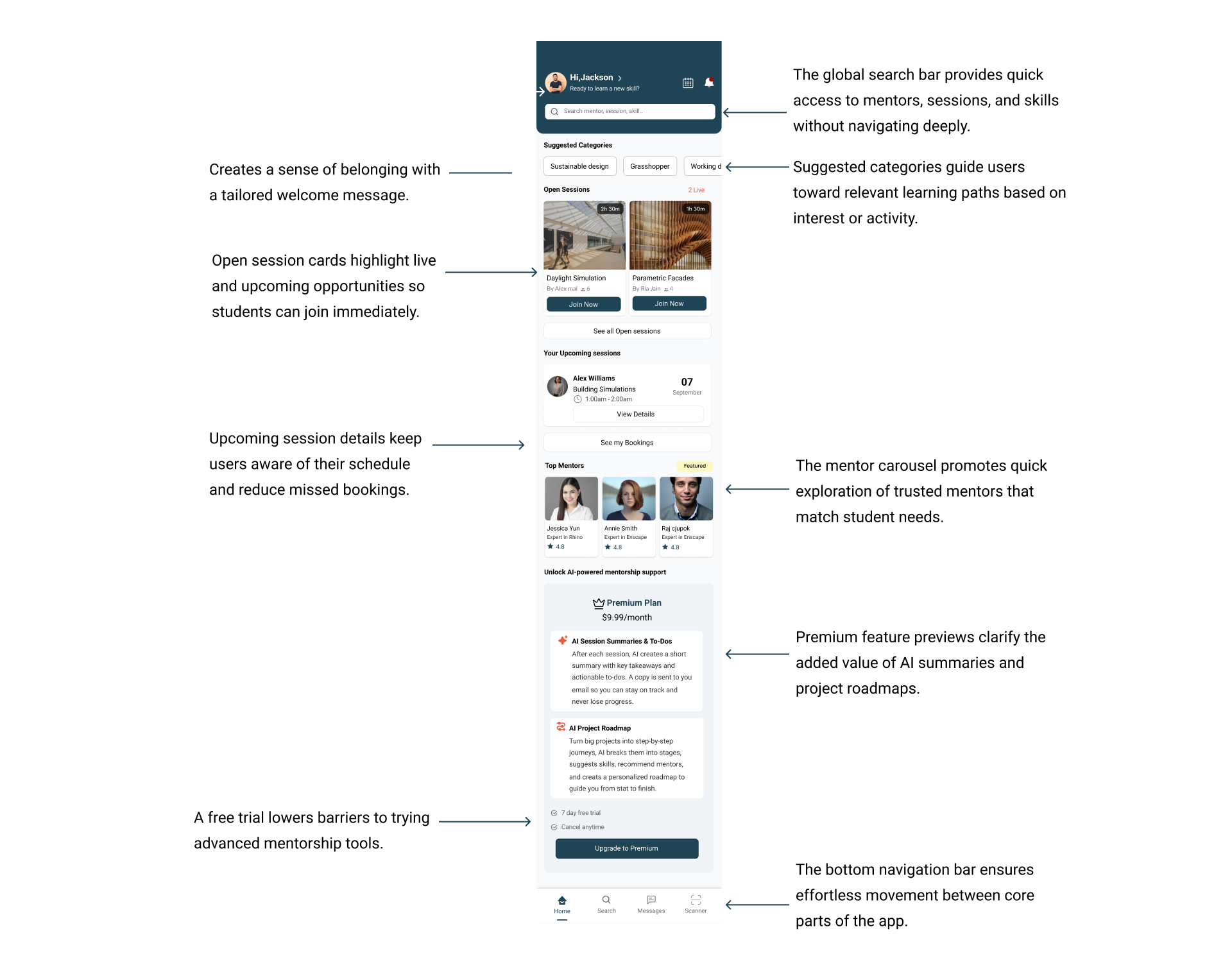
Annotated mockups: every decision on the mentor profile mapped to a research finding.
AI generates. Students edit. Mentors validate.
Three AI features, each one a draft a human refines:
AI Project Roadmap
Breaks a studio project into stages, suggests skills per stage, recommends mentors per stage. Editable end to end. Any section can be regenerated.
AI Live Notes
Captures key takeaways in real time during a session. The student tags any note as a to-do.
AI Session Summary
Structured recap and to-do list, emailed after the session ends.
This shape came directly from a failed pretotype. See Part 03.
What the free tier proves. What premium proves.
Free covers Skill Wall, mentor browsing, booking, live sessions. Premium ($9.99/mo, 7-day free trial) unlocks AI Roadmap and AI Summary. The free tier carries the visibility hypothesis. The premium tier carries the AI augmentation hypothesis. They are priced separately because they do separate jobs.
Part 03
The three things that could kill the thesis.
Pretotyping · 3 assumption tests · XYZ validation
Three pretotypes, each one testing an assumption that would sink the project if wrong. Each had an XYZ statement: hypothesis, population, threshold.
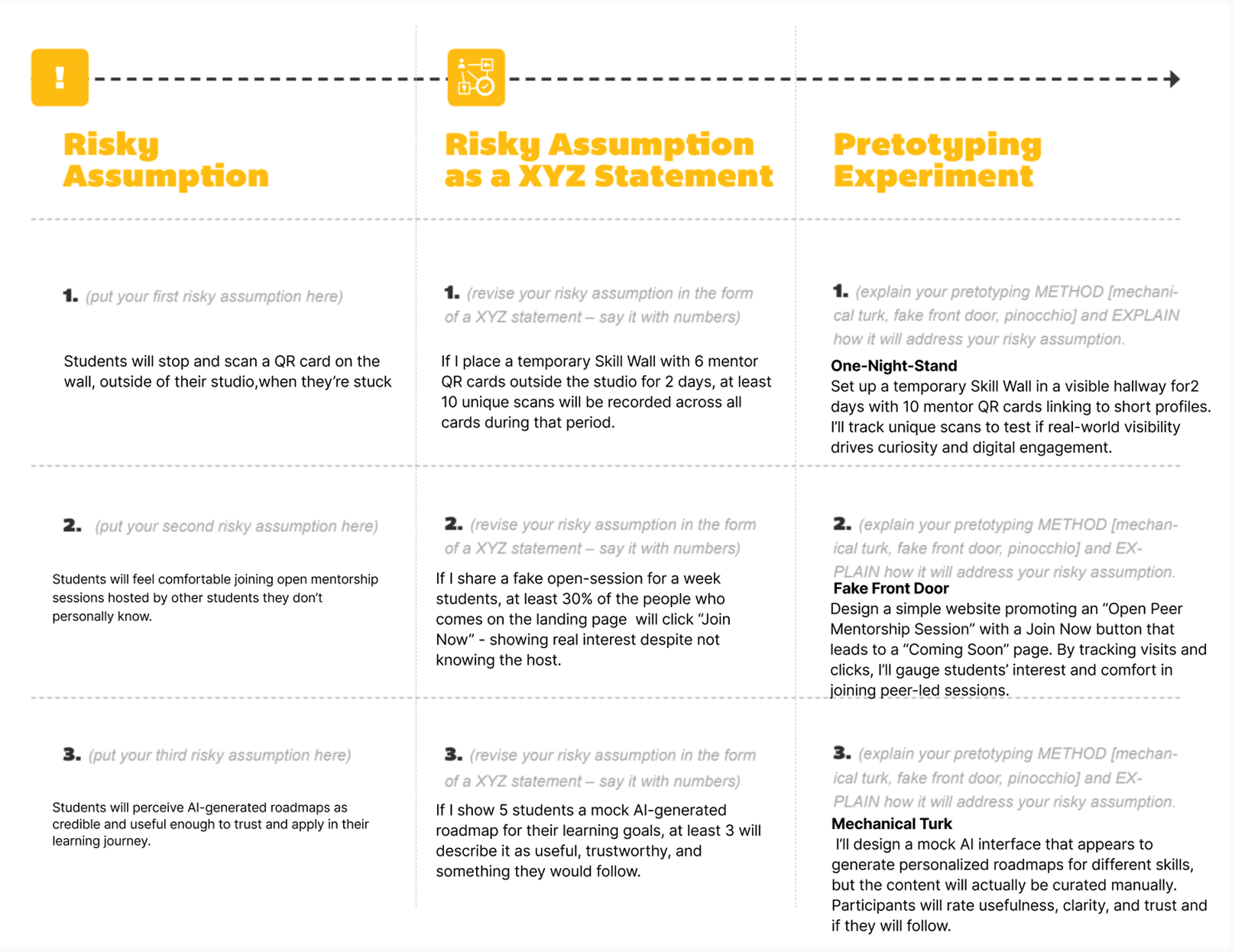
Risky-assumption matrix: the three highest-risk, highest-unknown assumptions became the three pretotypes.
Will students stop and scan a QR card on a hallway wall?
Six mentor QR cards posted in the studio hallway for two days. Threshold: 10 unique scans. Result: 14. Scans clustered in transitional moments, almost none during a panic. The wall belongs in the hallway, away from the studio entrance.
Will introverts opt into a peer-led session from a stranger?
A landing page advertising "Open Peer Mentorship Session," Join Now button, Coming Soon page behind it. Threshold: 30% click-through. Result: 35%. Killed the assumption that introverts would refuse peer-led sessions. They opted in at the same rate as everyone else. The session was framed as shared struggle, and the host was a peer rather than an authority.
Will students trust an AI to plan their learning?
A mock AI interface appearing to generate personalized roadmaps. Five students rated trust, relevance, and intent to follow. Threshold: 3 of 5 would call it useful and trustworthy. Result: 60% said no, 20% yes, 20% maybe.
Failed test, most useful finding. Students wanted to edit, regenerate, refine. They liked the structure. They didn't trust the AI to read their project correctly. Most explicitly said they wanted AI as a companion. They would not trust it as an authoritative planner.
That feedback rebuilt the AI feature. The roadmap is editable at every stage. Mentors are surfaced inside each step. The AI generates a draft. The student edits. The mentor validates. That loop came directly out of a failed pretotype.
Part 04
What watching five people fumble actually changed.
Usability testing · 5 participants · moderated think-aloud
Five architecture students, mobile prototype, moderated think-aloud. Mixed-method scoring on confidence and ease per task. Frequency-severity matrix on every issue.
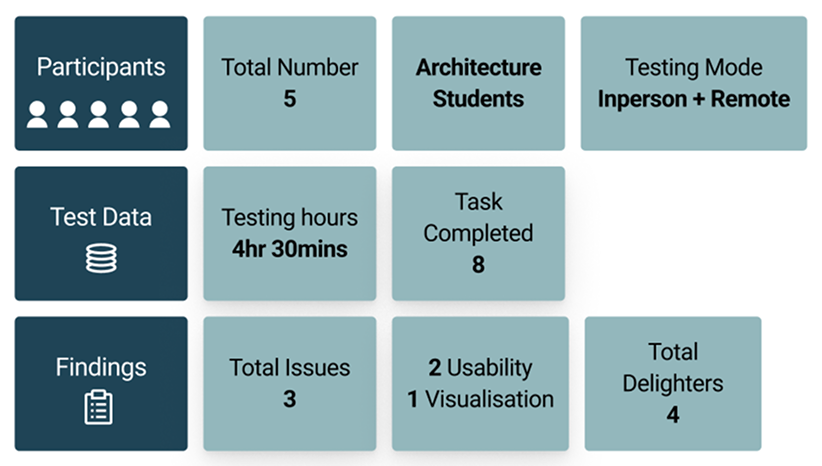
Usability testing: confidence and ease scored per task, then issues plotted on frequency vs. severity.
Card selectability. Users assumed the whole In-Person / Virtual session block was tappable. Only the radio button was. Fix: full card now selectable, radio button is a visual indicator.
Sticky CTA. Users scrolled past About, Portfolio, Reviews, then couldn't find Book Session. Fix: CTA pins to the bottom on the mentor profile.
AI affordance. A plain notes icon didn't communicate "AI-powered." Users overlooked the feature. Fix: added a small AI spark indicator. Discoverability without a tutorial.
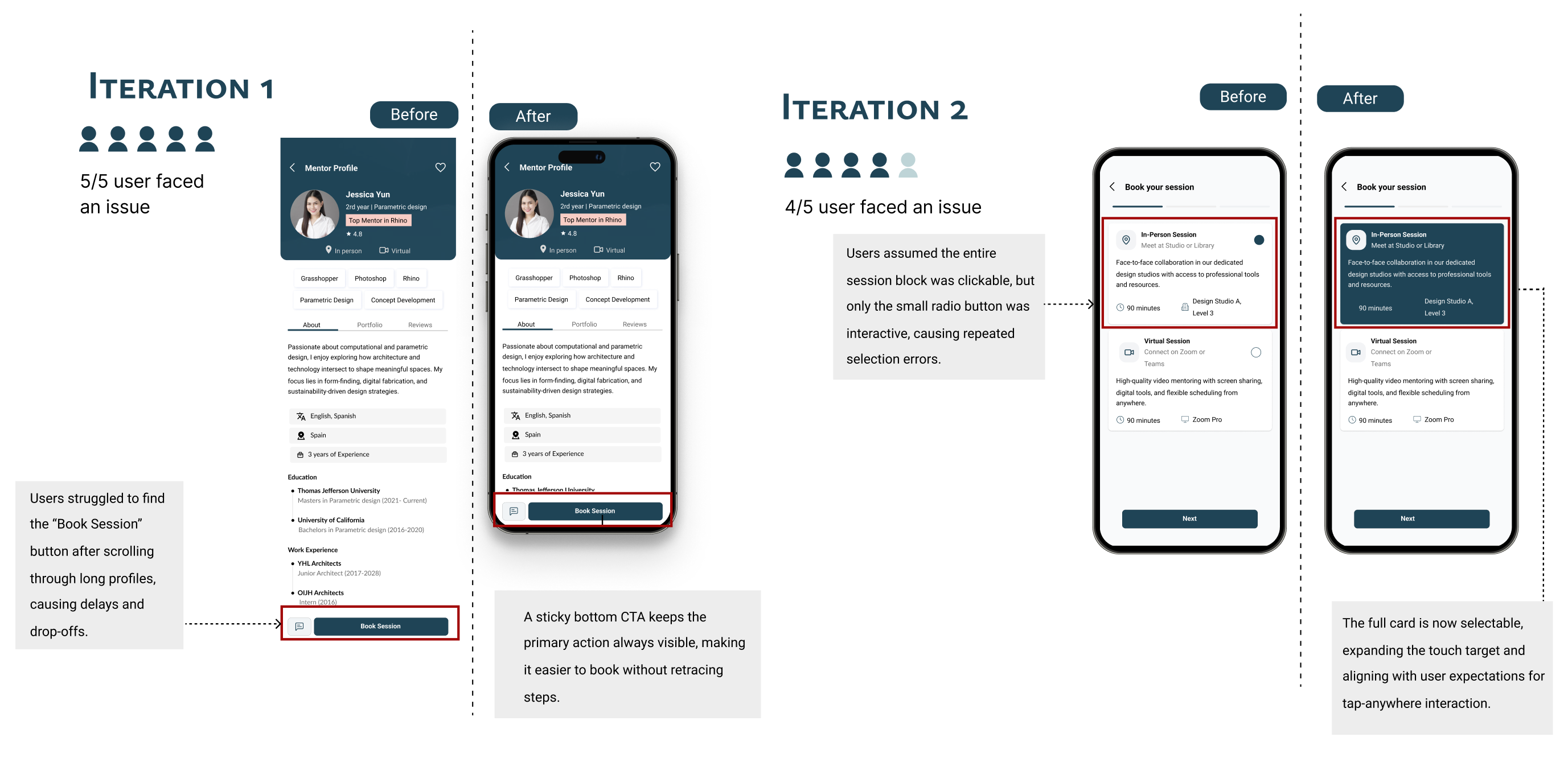
Iterations: card selectability, sticky CTA, AI affordance, each fix mapped to the test that surfaced it.
Boring fixes. The kind you only catch by watching five people fumble through the same micro-friction five times in a row.
Part 05
What it takes to put a Skill Wall in every studio.
Business model · revenue streams · growth strategy
What we're trying to make permanent.
Make skill visibility a permanent feature of studio culture. Not a thesis pilot. Not a one-program experiment.
Five ways this pays for itself.
Premium subscription
$9.99/mo, AI Roadmap + AI Summary
Institutional licensing
Campus-wide deployment for architecture departments
Workshops & training
Paid mentorship programs and skill workshops
Educational grants
Innovation funding for higher-ed pilots
Software partnerships
Rhino, AutoCAD, Revit, Adobe student bundles
What success looks like in numbers.
reduction in help-seeking time
reduction in skill acquisition timeline
adoption first-semester target
From one program to every design discipline.
Phase 1: architecture program. Phase 2: interior design, industrial design, graphic design, landscape architecture. Phase 3: cross-program ecosystem with a 40% lift in cross-discipline collaboration. The model transfers because the underlying problem, distributed and invisible expertise inside a project-based curriculum, is the same across every design discipline.
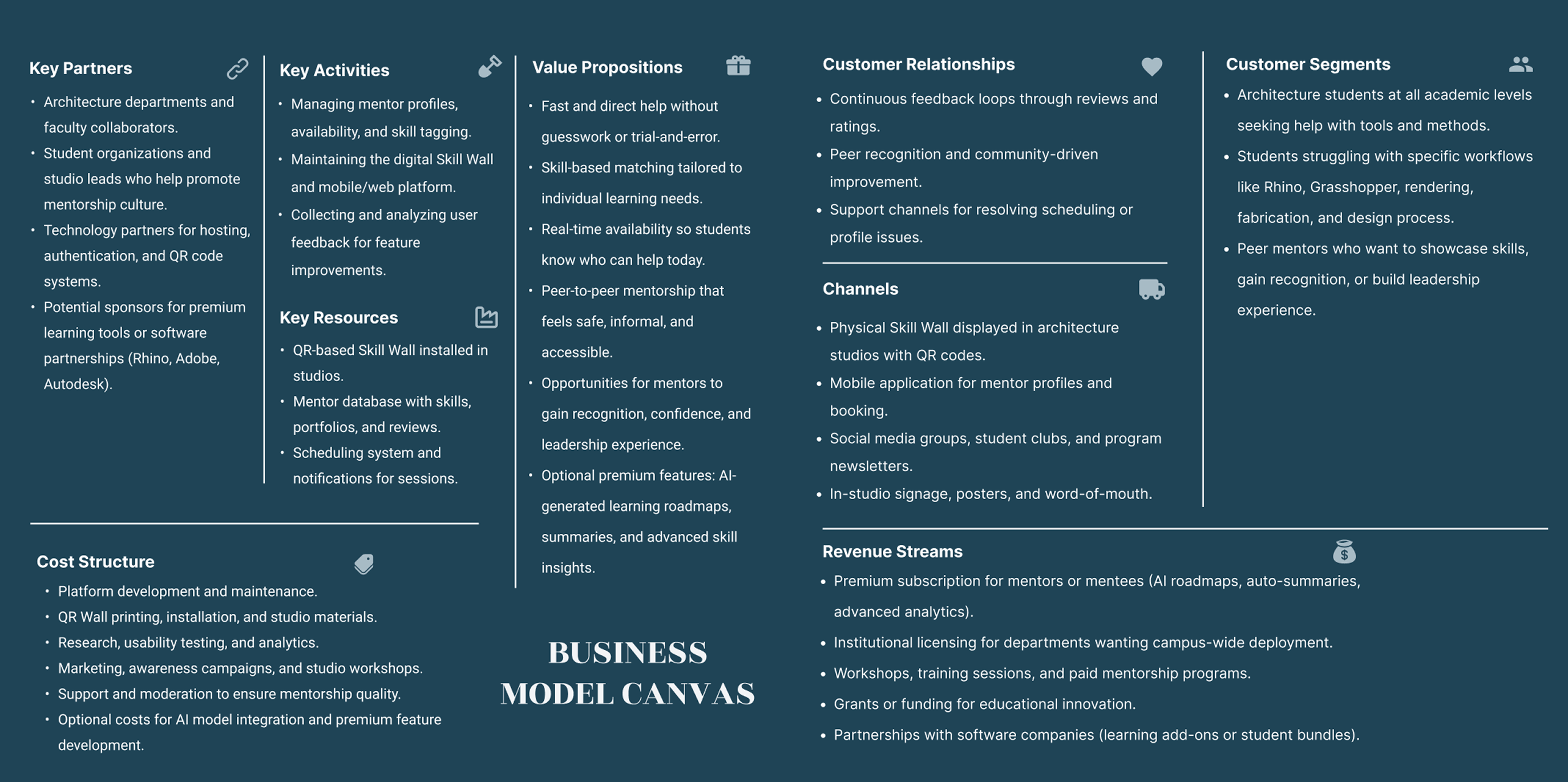
Business model canvas: revenue streams, partners, channels, and value propositions in one frame.
Reflection
Confidence is the real deliverable.
A year in, the phrase that stuck: confidence is the real deliverable.
Once mentorship reads as a visibility problem, the design reads differently. The Skill Wall works as a permission slip in disguise. Open Sessions become social proof that asking is normal. The AI Roadmap stops trying to replace planning and starts handling the cold-start, so the human conversation can do the real work.
Cheap experiments are more honest than pretty mockups. A printed wall in a hallway told the truth faster than two months of high-fidelity testing would have. The failed AI test saved the entire AI feature from shipping in the wrong shape.
"Research is the product. The artifact at the end is just where the research lands."
What's next: Three architecture departments at peer universities running concurrent Skill Walls. A longitudinal study tracking the 30% help-seeking-time reduction over a full semester.