Speculative Design · Accessibility · AI Wearable

Presence.

Smart glasses that help people with dementia live with more confidence, independence, and dignity.

Type Personal / Speculative
Platform Wearable + iOS
Focus Dementia Care, AI, Privacy

Where It Starts

A disease that steals
the familiar.

There are 55 million people living with dementia worldwide. By 2050, that number will triple.

But the statistics miss the truth of what dementia actually feels like day to day. It is not just memory loss. It is standing in your own kitchen and not knowing if the stove is on. It is looking at your son's face and reaching desperately for his name. It is the slow erosion of the small certainties that make a person feel safe in their own life.

The people who live with dementia are not defined by their diagnosis. They are parents, grandparents, friends, storytellers, gardeners, cooks. They deserve technology that treats them that way.
"The problem was never memory. The problem was the loss of confidence that follows."

Understanding the person, not the patient

A day in the life of someone living with dementia

Thinks & Wonders

  • Did I take my medication this morning?
  • Is that person familiar to me?
  • Have I left something on in the kitchen?
  • I don't want to ask again. I already asked.
  • Am I safe right now?

Feels

  • Anxious in unfamiliar situations
  • Embarrassed when forgetting faces
  • Frustrated by dependence on others
  • Isolated from social life
  • Relieved when family is nearby

Does

  • Asks the same question multiple times
  • Avoids social situations to hide confusion
  • Relies heavily on caregivers for basics
  • Checks locks and appliances repeatedly
  • Withdraws from conversations

Says

  • "I'm fine." (when they are not)
  • "I remember." (reaching for certainty)
  • "I don't need any help."
  • "I know who you are." (to cover doubt)
  • "I just forgot for a moment."

Designed from empathy, not assumption.

The Opportunity

Technology that helps without
announcing itself.

Most assistive technology for dementia falls into one of two traps. It is either so complex that the person who needs it cannot use it, or so clinical that wearing it broadcasts vulnerability to everyone in the room.

A GPS tracker worn around the neck. A panic button clipped to a shirt. These are not bad solutions. But they are solutions that constantly remind the person wearing them that something is wrong.

Presence was designed around a different belief: that the best assistive technology is the kind you forget you are wearing. That support should be quiet. Private. Dignified. And above all, invisible to everyone except the person who needs it.

Why existing solutions fall short

A comparison of approaches to dementia support technology

Existing Apps

  • Require screen interaction
  • Need caregiver management
  • Phone must always be accessible
  • Overwhelming for late-stage users
  • No real-time environmental awareness

Medical Wearables

  • Visually stigmatizing
  • Clinical aesthetic
  • Limited to location tracking
  • No social or contextual support
  • Battery-intensive alert systems

Presence

  • Worn like normal glasses
  • On-device AI · fully private
  • Face recognition in real time
  • Environmental monitoring built in
  • Gentle audio · invisible to others
  • Designed for dignity, not dependency

The Product

Presence.

Presence is a pair of AI-powered smart glasses designed specifically for people living with early to mid-stage dementia. They look like ordinary glasses. They feel like ordinary glasses. But inside, they are quietly working: recognizing faces, monitoring the environment, and whispering gentle reminders only the wearer can hear.

No touchscreen. No app to open. No button to press. Presence works automatically, in the background, all day long.

Presence smart glasses — product overview with component annotations

Five components. One purpose: quiet, dignified support.

Forward-Facing Camera

Recognizes faces in real time using on-device AI. No image is ever stored or sent anywhere.

On-Device AI Processor

All processing happens locally on the glasses. No cloud connection required. No data leaves the device.

Open-Ear Speaker

Whispers privately to the wearer. A name. A reminder. A gentle alert. Inaudible to anyone nearby.

Micro-Display Overlay

Shows subtle visual cues in the lens, visible only to the wearer. Names, reminders, safety alerts.

In the Lens

What the wearer sees.

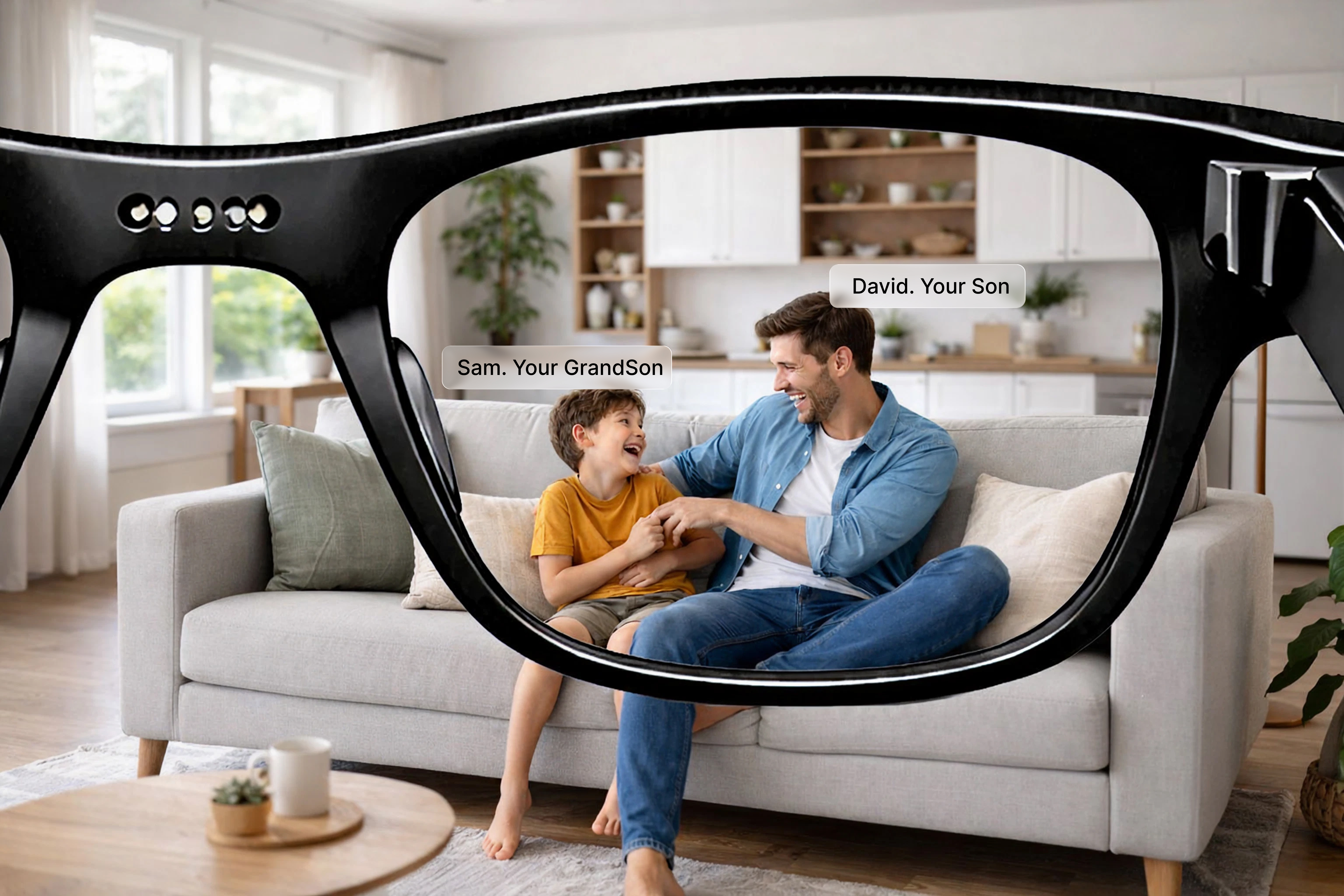
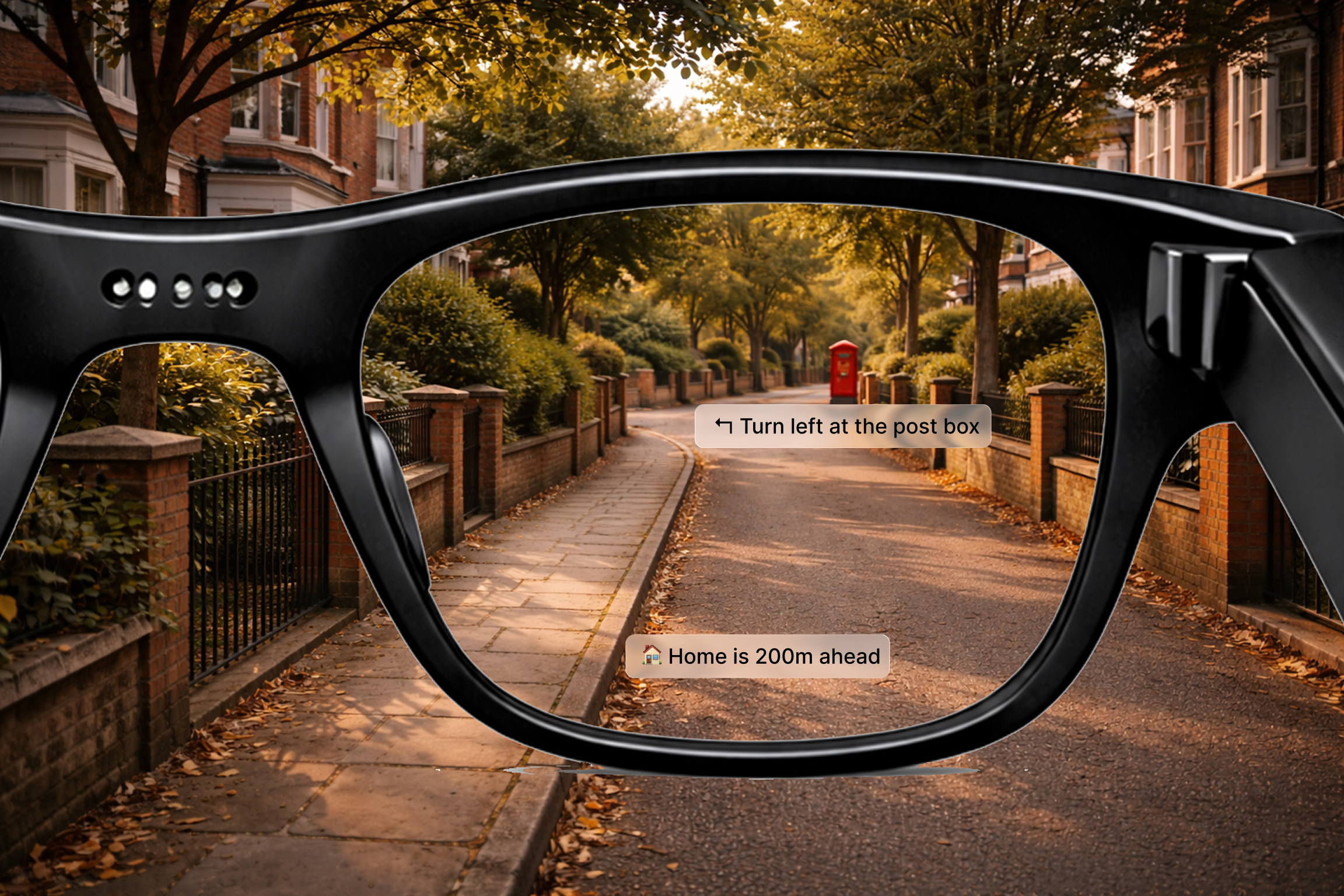
Two of the most common moments of confusion for someone with dementia: a familiar face they cannot name, and uncertainty about whether an appliance is safe. Presence handles both, quietly.

Family member arriving at the door

"David. Your Son." Whispered privately the moment he walks in. No one else hears it.

Glasses view showing street navigation — turn directions and distance to home

"Turn left at the post box. Home is 200m ahead." Gentle navigation for familiar routes that feel suddenly unfamiliar.

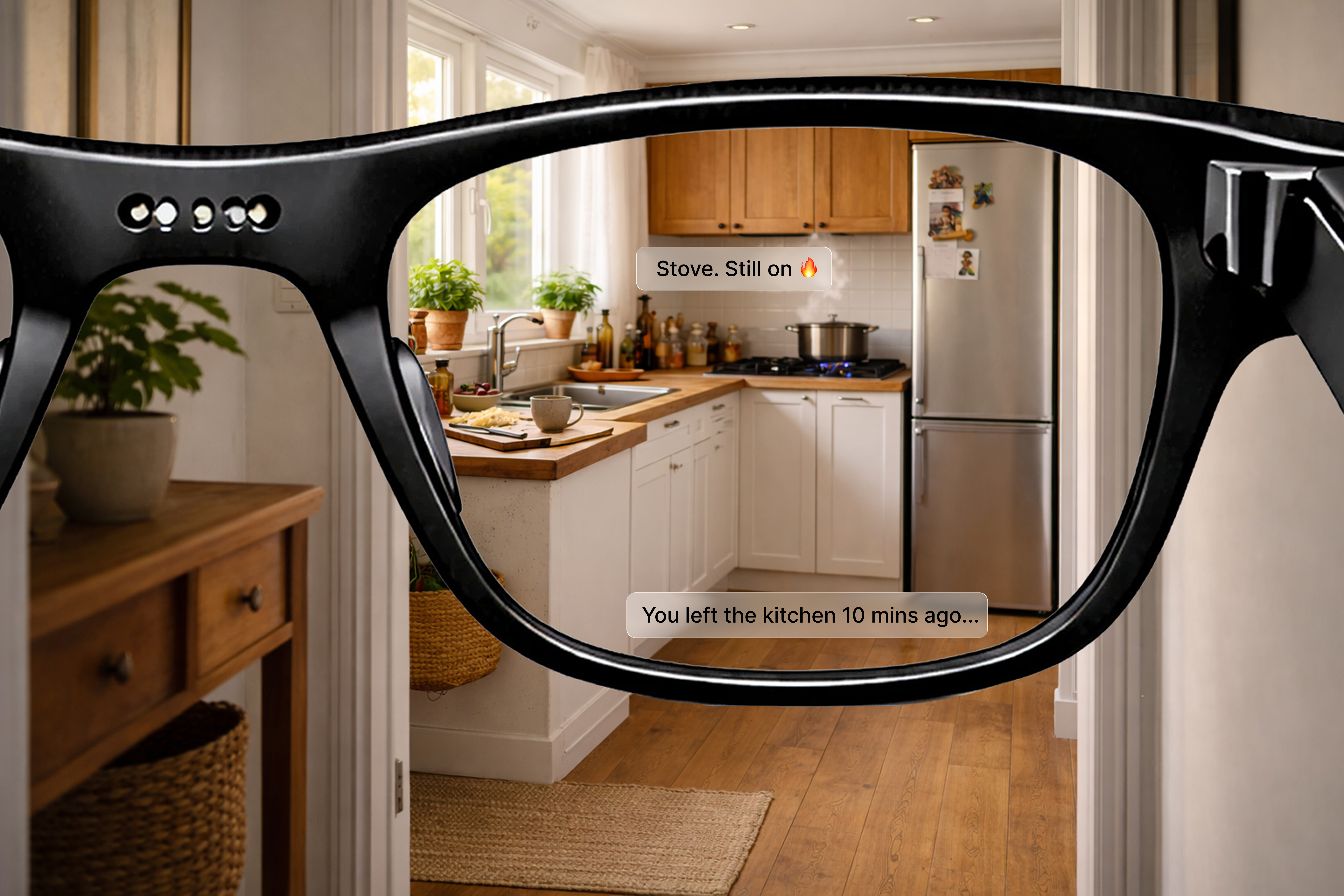
Kitchen stove with Presence safety monitoring

"Stove. Still on. You left the kitchen 10 minutes ago." A gentle reminder, not an alarm.

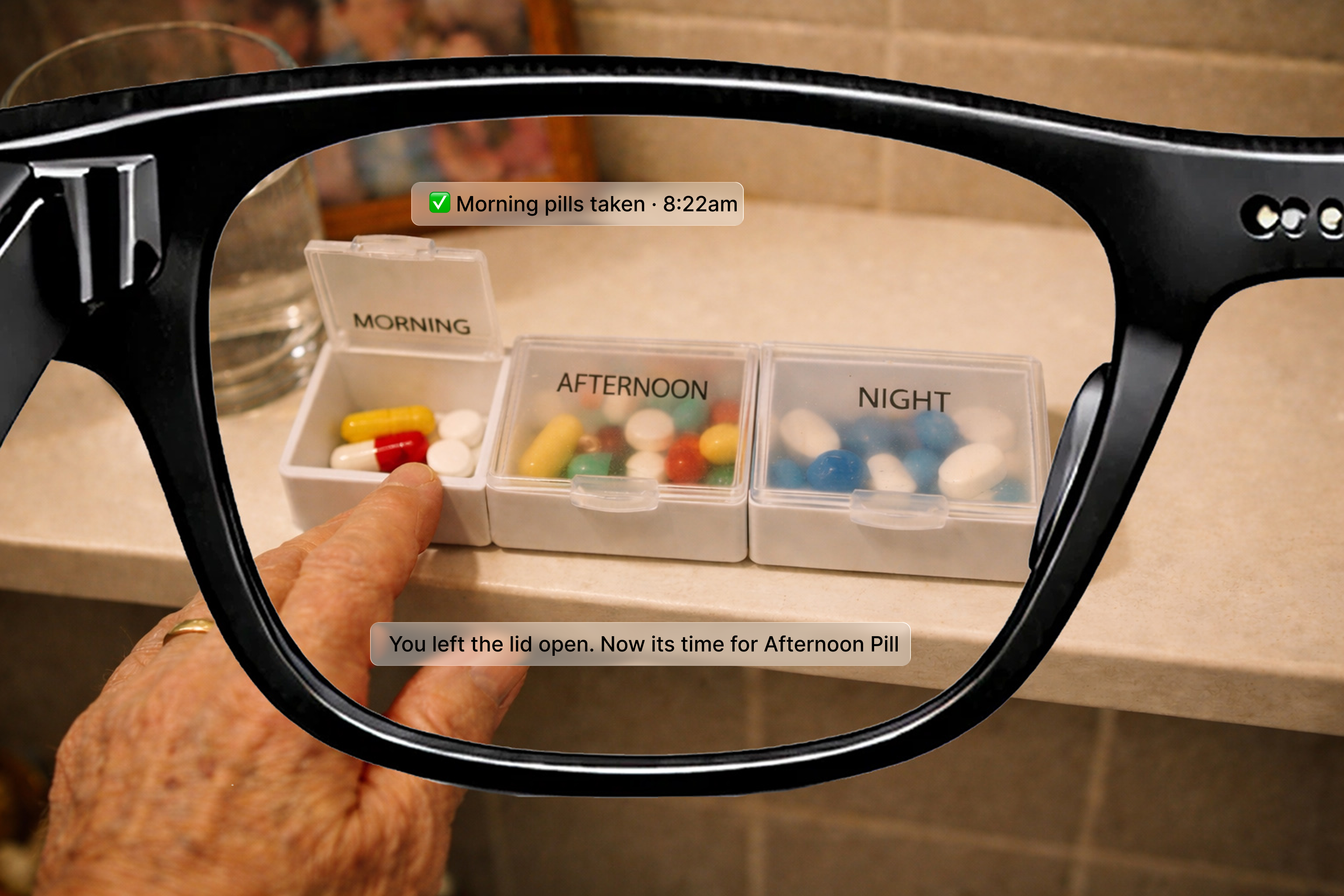
Glasses view showing medication detection — morning pills confirmed and afternoon reminder

"Morning pills taken · 8:22am. Now it's time for your afternoon pill." Medication confirmed without asking, without a phone, without any effort.

A day in the life.

How Presence shows up: quietly, consistently, invisibly.

08:00 am Medication Confirmed Safety
Glasses detected Eleanor took her morning medication on time. The day starts with certainty.
09:30 am David Recognised People
David arrived at the front door. Glasses whispered "David. Your Son." Eleanor greeted him by name. He will never know she needed help.
11:00 am Unfamiliar Face Safety
An unfamiliar person rang the bell. Glasses whispered "Unknown person at the door." Eleanor waited for David to answer. Quietly safe, without panic.
12:30 pm Stove Reminder Environment
Eleanor had been in the kitchen for 12 minutes. Glasses whispered "Stove. Still on." She turned it off. No alarm, no panic. Just a quiet prompt.
02:00 pm Word Support Words
During a conversation, Eleanor paused mid-sentence, reaching for a word. Glasses whispered "Brighton," the town she was describing. The story continued.
04:30 pm James at the Door People
James rang the bell. Glasses noted 58% confidence: "This might be James. Not certain." Eleanor checked through the window before answering. Caution over assumption.
06:00 pm Evening Medication Safety
Evening medication confirmed on time. Day summary: 2 people recognised, 1 stove reminder, 0 alerts. A full day, lived with confidence.

The Companion App

For the people
who love them.

Presence is not just a device. It is a system of care.

The companion iOS app gives family members and caregivers a private window into their loved one's day, without being intrusive, without creating surveillance, and without removing the independence that makes life feel worth living.

Three screens. Three roles. Each one designed for a different kind of caring.

Screen 01

Home

Live status of the glasses. Battery, connection, current mode. Quick controls for volume and mute. A summary of what Presence did today.

Screen 02

My People

The faces your glasses know. Recognition confidence per person. Easy to add new faces and update photos as people change over time.

Screen 03

My Day

A private timeline of the full day. Every person seen. Every reminder given. Every medication confirmed. A quiet record of a life fully lived.

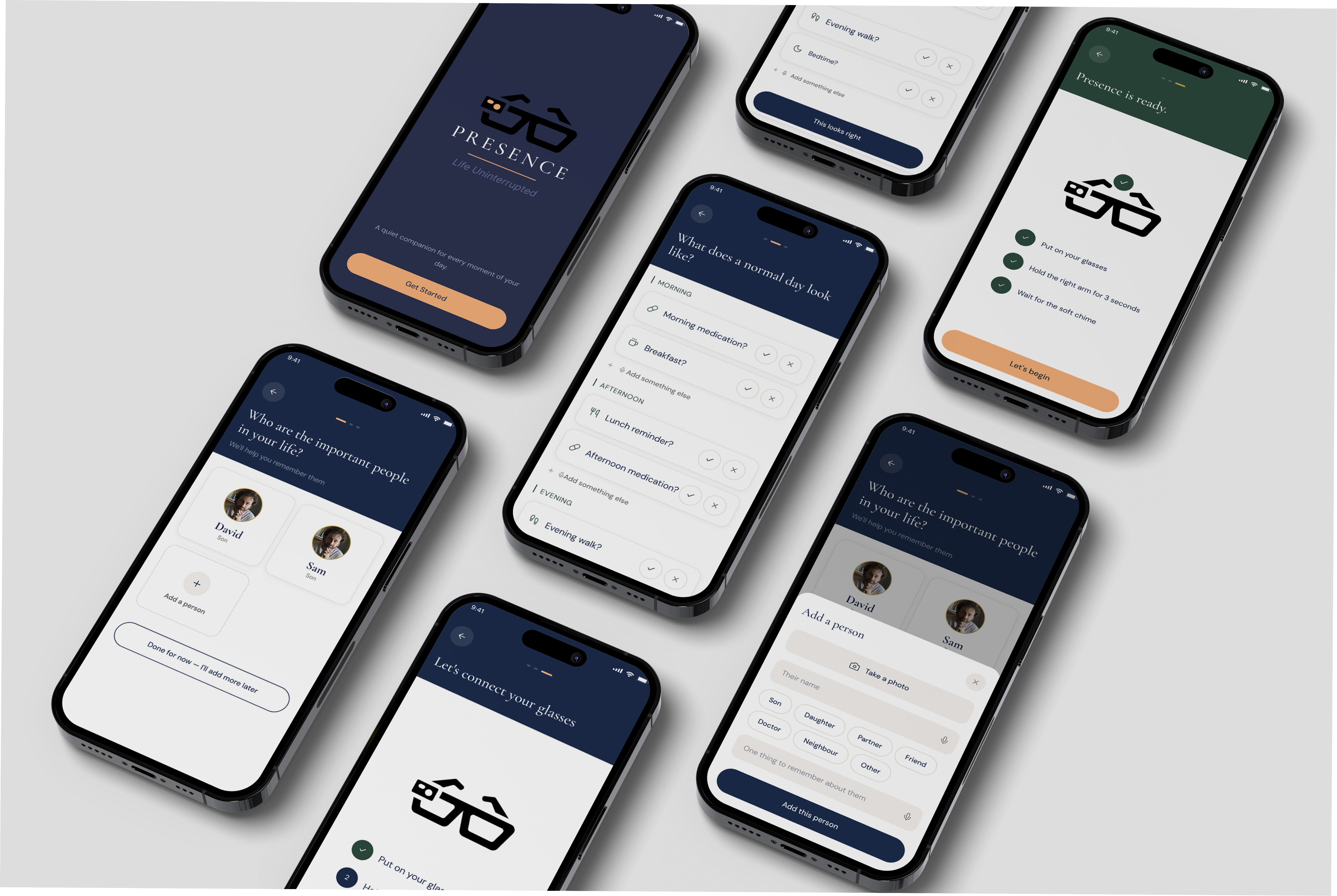
Onboarding screens — setting up people, daily routine, and glasses connection

Onboarding designed for simplicity: set up your people, your routine, and your glasses in minutes.

Presence companion app — three screens showing Home, My People, and My Day

Designed for the wearer, not the caregiver. Control always stays with the person.

See It in Action

The concept,
brought to life.

A short film showing how Presence works in a real day, from morning medication to an evening conversation. Designed to show what quiet, dignified support actually feels like.

Design Principle

Private by design.
Not by policy.

Every decision in Presence was made through the lens of privacy. Not as a legal requirement. Not as a feature to market. But as a fundamental act of respect for the person wearing it.

People living with dementia are among the most vulnerable to data exploitation. Their routines, their faces, their daily patterns: these are deeply personal. Presence was designed so that none of it ever leaves the device.

On-device only No cloud. No third parties. You control your data. Always.

Designer's Note

What building Presence
taught me.

I started this project thinking about technology. I ended it thinking about people.

Designing for dementia means designing for a person who is losing their grip on the familiar, and who deserves, more than most, to feel like the technology in their life is on their side.

Every interaction in Presence had to earn its place. If a feature created anxiety, it was cut. If a reminder felt like an alarm, it was redesigned until it felt like a whisper. If something required the user to remember how to use it, it was rebuilt until it required nothing at all.

The hardest design constraint was also the most clarifying one: the person wearing Presence should never feel like they are using assistive technology. They should just feel like themselves, moving through their day, a little more confident, a little more connected, a little more at ease.

"The best design for someone who is losing their memory is design that requires none."

Back to Playground